India’s rural jobs debate is being rewritten. The question is no longer just “how many days of work,” but “what kind of work, for whom, and in service of which food system.” MGNREGA’s original promise of rights-based employment and regeneration of local commons now sits uneasily beside a push towards a more centralised, mission-style rural jobs law that risks recentralising decisions and diluting worker voice.
MGNREGA: When a wage becomes a soil and water policy
When MGNREGA works well, it quietly does three things that no single agriculture or welfare scheme manages to do together. It stabilises incomes in the lean season, it rebuilds local ecologies, and it shifts a bit of bargaining power back towards women and landless workers. A hundred days of guaranteed work, even if households actually get only 70–80 days on average, means money for food, school, medicine and debt servicing at precisely the time agriculture shuts down.
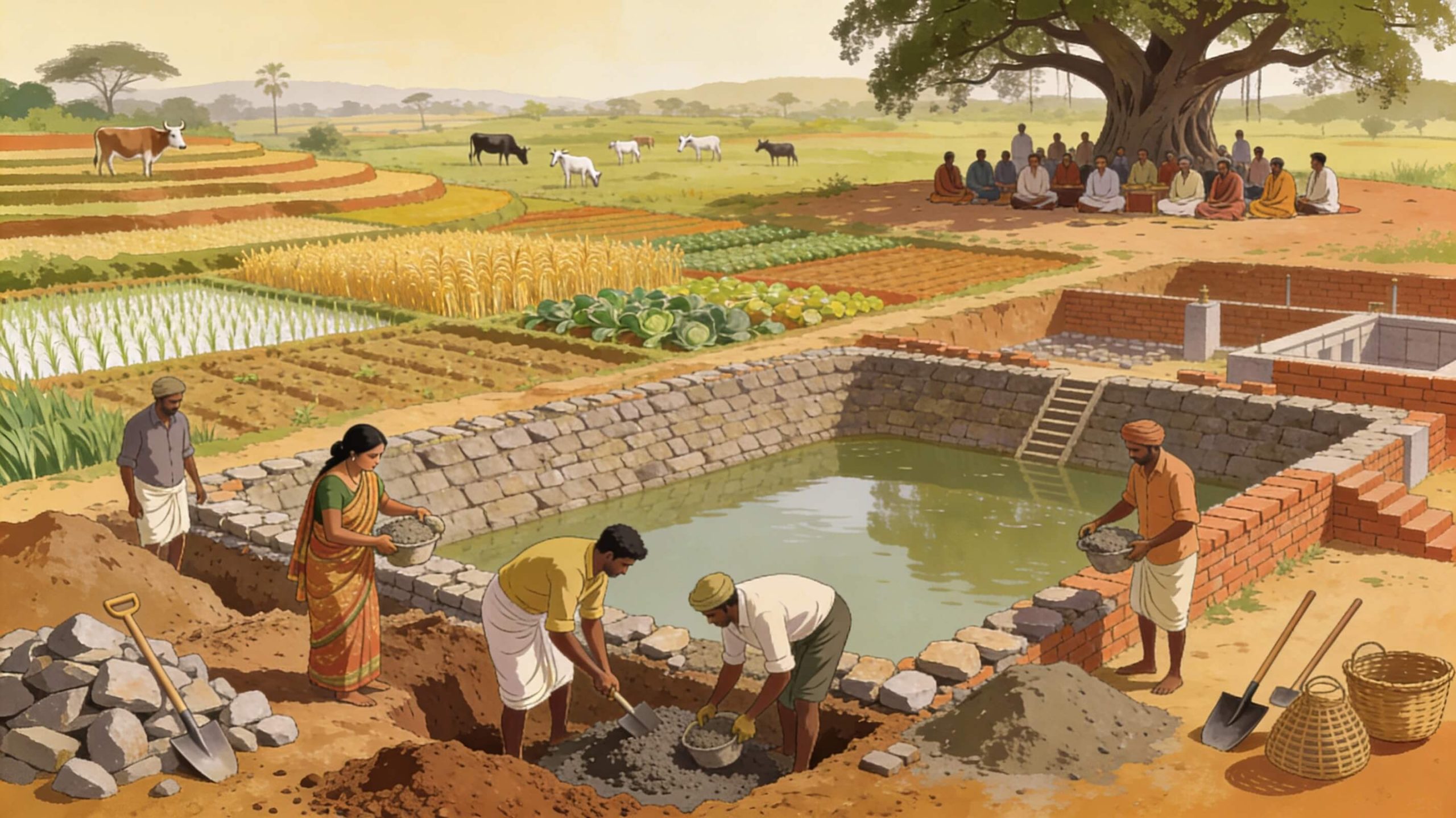
Less visible, but just as important, is the way MGNREGA has become India’s largest public investment in water and soil. With at least 60% of spending earmarked for agriculture and allied NRM works, and three-quarters of permissible works now linked to land and water, the scheme has effectively become a climate adaptation programme for small farmers. Farm ponds, check dams, contour bunds and land levelling are not just “assets” in a database; they are the hidden infrastructure that decides whether a village can risk millets, pulses and fodder crops instead of retreating into low-diversity, high-risk monocultures.
New amendments: Water gains, local autonomy at risk
The recent mandate that 65% of spending in over-exploited blocks, 40% in semi-critical, and 30% even in safe blocks go to water conservation sounds, on the face of it, like a technical tweak. In reality, it is a profound political choice about who decides the village’s development priorities. For water-stressed regions, this earmarking can be a windfall, if Gram Sabhas can still decide which water bodies matter, which catchments to heal, and how these structures fit into cropping patterns, grazing routes and village food plans.
The danger is that centrally defined groundwater categories become the new “commandments,” and MGNREGA turns into a race to tick water-structure boxes rather than a process of ecological planning. When top-down quotas override local knowledge, the programme moves away from food systems thinking, where water, soil, seeds, livestock and markets are co-designed and back towards a narrow engineering logic. The irony is sharp: in the name of saving water, villages may lose the autonomy to decide which commons to revive first.
The new rural jobs law: Infrastructure without livelihoods?
The proposed VB-G RAM G framework, pitched as a radical revamp of rural employment after twenty years of MGNREGA, raises the stakes dramatically. The estimated cost of around ₹1.51 lakh crore annually, with a heavier burden on state finances, signals an ambition to build more and bigger infrastructure. But it also brings with it a harder compliance regime, with penalties reportedly being ramped up from ₹1,000 to ₹10,000 in some cases, and tighter windows within which employment guarantees can actually be accessed.
From a food-systems and decentralised livelihoods perspective, three red flags stand out. First, the tilt from a demand-driven right to work towards a supply-driven project pipeline risks rationing work precisely when climate shocks and price crashes hit. Second, if the new framework privileges larger, contractor-heavy infrastructure, the lowest-skilled, most marginal rural workers especially women, Dalits, Adivasis and landless labourers could find themselves pushed out of accessible local work. Third, a techno-bureaucratic focus on assets rather than relationships may weaken Gram Sabha control over what gets built, where, and for whose benefit. In that world, rural jobs become an input into an infrastructure agenda, not a pathway to secure, dignified livelihoods anchored in local ecologies.
Food systems, not just fiscal arithmetic
The current debate is trapped in fiscal and efficiency language: how much the Centre should pay, how much the states can bear, how to control “leakages.” Missing from this conversation is a simple truth: the shape of our rural employment law will also shape the country’s food systems for decades. If work is organised around water harvesting, soil health, seed diversity, pasture restoration and village-level storage and processing, then each day of labour under a jobs programme becomes an investment in a more diverse, resilient food economy. If, instead, work is driven by short-term asset targets and contractor logic, then the scheme may produce concrete but not necessarily nourishment either for people or for landscapes.
MGNREGA has already demonstrated that when Gram Sabhas are empowered, SHGs and farmer groups participate, and local planners take agroecology seriously, employment works can underwrite pulses and millets, backyard livestock, kitchen gardens, common grazing grounds and tree-based systems. These are the building blocks of decentralised livelihoods, where income is spread across seasons and activities rather than hinging on a single crop and a volatile market. Undermining this potential in the name of “reform” would be a historic mistake.
A different reform agenda: Deepen the commons, don’t dilute the right
The real reform India needs is not to replace MGNREGA’s rights-based spine with a more centralised, punitive architecture, but to double down on its original spirit and correct its well-documented implementation failures. That means three non-negotiables if rural employment is to support a just food system:
- Put Gram Sabhas back at the centre, with binding powers over the selection, design and sequencing of works, and mandatory representation of women, landless workers, and small farmers in planning committees.
- Hard-wire agroecology, commons and decentralised livelihoods into the shelf of projects: water and soil structures linked explicitly to diversified cropping plans; protection and expansion of grazing lands; village seed banks; small-scale food processing and storage; and local market infrastructure that shortens supply chains.
- Fix the nuts and bolts of the right: time-bound wage payments with automatic compensation, open and auditable MIS, independent social audits with teeth, and legal remedies when work is not provided within the stipulated period.
A rural employment law is not just an anti-poverty tool. It is a constitutional statement about whose labour is valued, whose knowledge counts, and whether the republic trusts its villages to shape their own futures. The choice before India now is stark: turn a living right into a tightly managed scheme, or use this moment to anchor a new generation of food-systems and commons-centred livelihoods. In that decision lies the real measure of any “radical revamp.”